

Technology
Mobile
According to figures from the Commission for Communications Regulation, there are 5.7m ‘ordinary’ mobile telephony subscriptions (that is, excluding mobile broadband and machine to machine subscriptions) in Ireland as of Q1 2023. This means that there are 109 subscriptions for every 100 people in the population. Three companies dominate the market: the Three Group (43.6% market share), Vodafone (33.2%) and Eir (14.8%). The remainder of the market is accounted for by OAOs (“Other Alternative Operators”). OAOs do not have their own infrastructures but enter into contracts with one or more of the big three to rent capacity on their networks. Tesco Mobile, which accounts for 4.8% of all subscriptions as of Q1 2023, is the leading OAO using the network of Three Ireland.
Broadband
Mobile Phone Operators are also significant players in the broadband market. 339,293 of a total of 1.96m broadband subscriptions in Q1 2023 were provided via mobile services. Three is again the leading player accounting for 43.2% of all mobile broadband subscriptions, while Vodafone and Eir account for 39% and 17.8% respectively.
Within the Fixed Broadband market, subscribers are connected via a number of technologies: FTTP (“Fibre to the Premises”), VDSL (“Very-high-bit-rate digital subscriber line” which is delivered over twisted copper pairs-based infrastructure”), Cable Broadband and DSL (“Digital Subscriber Line” – again provided over voice lines). FTTP and VDSL predominate here respectively accounting for 537,244 and 513,916 of the total 1.6m fixed broadband lines in Ireland.
Eir is the leading player in fixed broadband accounting for 27.6% market share as of Q1 2023. Followed by Virgin Media (23.6%), Vodafone (20%) and Sky (14.5%) who generally use Eir’s infrastructure to deliver broadband speeds.
According to statistics from the European Commission 96.4% of all Irish households had potential access to Next Generation Broadband as of 2021. (That is, they were located in areas covered by broadband availability.) Higher speeds are less available: only 90.1% of households could access the internet at speeds in excess of 30 mbps and just 67.4% could avail of at speeds over 1gbps. There is a clear urban/rural split in this regard. Whereas the entirety of Dublin on the east coast had access to Next Generation broadband, this figure falls to between 65% and 95% as one looks to the less densely populated midlands and west coast.
Figures from the Irish Commission for Communications Regulation (Comreg) suggest that just 71% of Irish households actually subscribe to broadband services. The acknowledged disparity in the availability of high-speed broadband provision in the west of Ireland, led to the drawing up of a National Broadband Plan on the part of the state. Although progress has been very slow – originally conceived in 2012, a contract to actually deliver the plan was not awarded until 2019 – the plan is very ambitious and constitutes the single most valuable contract (up to €2.9bn) ever awarded by the state. The expansion of the broadband services to previously unserved rural areas envisaged by the plan is due to be completed by 2026. The state’s national digital strategy “Harnessing Digital” envisages making 1GB broadband universally available by 2028.
Fixed Telephony
Mobile telephony has long since eclipsed fixed line telephony as a means of voice communication. As of Q1 2023, total fixed line voice minutes amounted to 371m minutes as compared with the 3.2bn voice minutes accounted for by mobile. This is reflected in revenues where the total value of mobile voice revenues was €306m in Q1 2023, as compared with €101m for fixed voice revenues.
Within the fixed voice market, the top four companies account for 87.1% of the market led by Eir on 43.3%, Virgin Media on 20%, Vodafone on 13.4% and Sky on 10.4%.
The reappearance of several companies in different sectors above reflects the extent to which the delivery of services is bundled into dual, triple or quadplay offerings combining fixed voice telephony, television, broadband and mobile telephony. Of the 2.41m fixed subscriber lines in Ireland, 1.16m are “bundles”.
Mobile, Fixed Telephony, Broadband and Television Distribution Market Share 2022
Mobile | Fixed Telephone | Mobile Broadband | Fixed Broadband | Television Distribution (by main technology reception) | Revenues 2022 (€Mio) | |
|---|---|---|---|---|---|---|
Three | 43.6 % | 43.2 % | 579 | |||
Vodafone | 33.2 % | 13.4 % | 39 % | 20 % | 936.4 | |
Eir | 14.8 % | 43.3 % | 17.8 % | 27.6 % | 6 % | 1244 |
Virgin Media | 20 % | 23.6 % | 16 % | 385 | ||
Sky | 10.4 % | 14.5 % | 37 % |
Mobile, Fixed Telephony, Broadband and Television Distribution Market Share 2022
|
Foinse: Mobile, Telephony and Broadband: ComReg Data Portal. Television Distribution: TAM Nielsen. Revenues: Financial Statements filed with Companies Records Office.
Television Distribution
The Irish broadcast television ecology overlaps to some extent with the broadband market, reflecting the variety of technologies used to distribute television signals into Irish homes and businesses. The market is fully digital with the analogue terrestrial signal having been switched off permanently in October 2012.
Many homes avail of a number of distribution technologies simultaneously. This is captured by figures from TAM Nielsen, the television ratings agency, which record both the total presence of such technologies in Irish homes and which technologies are primarily used in individual homes.
Television Distribution Market by Distribution Technology 2023
|
Source: TAM Nielsen Establishment Survey July 2023
Saorview, the Irish Digital Terrestrial Television (DTT) operator, owned by RTE and operated by their subsidiary 2RN is in more homes (656,000 out of a total of 1,736,000) than any other technology/distributor. However, for most Irish homes with Saorview, DTT is a secondary mode of reception used in conjunction with satellite, cable or other broadband distribution technologies. Those homes for which Saorview is the primary mode of reception tend to be located in less populated, rural areas not yet served by cable or fibre infrastructures. Saorview carries a limited number of channels, essentially just those operated by RTE, TG4 and Virgin Media Television (although Sky News is also currently available).
Sky Digital, which enjoys a de facto monopoly in the Irish subscription satellite market, is the largest primary television distribution operator in Ireland. Virgin Media Television is the largest cable operator and, again, enjoys a de facto monopoly in the cable market. Eir, which had 945,000 broadband subscribers as of Q2 2023 is also increasing its presence in the television market using its infrastructure to offer IPTV distribution to 91,000 customers. Though requiring different infrastructures the suite of channels offered by Sky and Virgin are largely identical. Virgin Media customers can access Sky’s subscription movie and sports packages and Sky customers can access Virgin Media’s channels. Eir’s “main” channels also largely mirror the basic packages offered by Sky and Virgin although subscription services such as Sky sports are not currently directly via Eir.
An increasing number of Irish homes have engaged in “cord-cutting” - that is they do not subscribe to any television content-specific distribution services. However, they may still access content via broadband and watch content via a smart TV or via a computer. Though such access is not necessarily illegal, it is estimated that 5% of Irish homes have installed what are colloquially referred to as “dodgy boxes” which allow users to access both free-to-air and subscription content. In such cases the subscription content is effectively pirated since the rights holders for the Irish market are not receiving any payment for such access.
Social Media and Online Platforms
Ghlac na hÉireannaigh go fonnmhar le húsáid na meán sóisialta. Tugann figiúirí ó Kepios le fios gur bhain 4 mhilliún duine (nó 80% den daonra) úsáid as na Meáin Shóisialta ó Eanáir 2023.
Léirítear é seo le méadú de réir a chéile ar úsáid na meán sóisialta mar fhoinse nuachta. De réir Thuarascáil Nuachta Digiteach Reuters d’Éirinn, tá méadú ó 16% in 2017 go 20% in 2023 ar an gcéatadán den daonra a úsáideann na meáin shóisialta mar phríomhfhoinse nuachta. (Maidir le fáil nuachta ar líne – gan na meáin shóisialta san áireamh – tá méadú tagtha freisin air ó 28% go 32% thar an tréimhse chéanna agus tá anois ar chomhchéim leis an teilifís mar phríomhfhoinse nuachta.) Tá úsáid na meán sóisialta le haghaidh nuachta an-choitianta go háirithe i measc an aosa óig: is í an fhoinse nuachta is coitianta í do dhaoine 18-24 bliana d’aois agus sáraíonn sí an teilifís, an raidió agus nuachtáin phriontáilte i measc daoine idir 18-44 bliain d’aois.
Irish Social Media Market 2023
|
Source: Kepios Datareportal. Digital 2023: Ireland
Éire mar Bhunáit na bhFathach Teicneolaíochta san Eoraip
The Irish have actively embraced the use of social media. Figures from Kepios suggest that 4 million people (or 80% of the population) used Social Media as of January 2023.
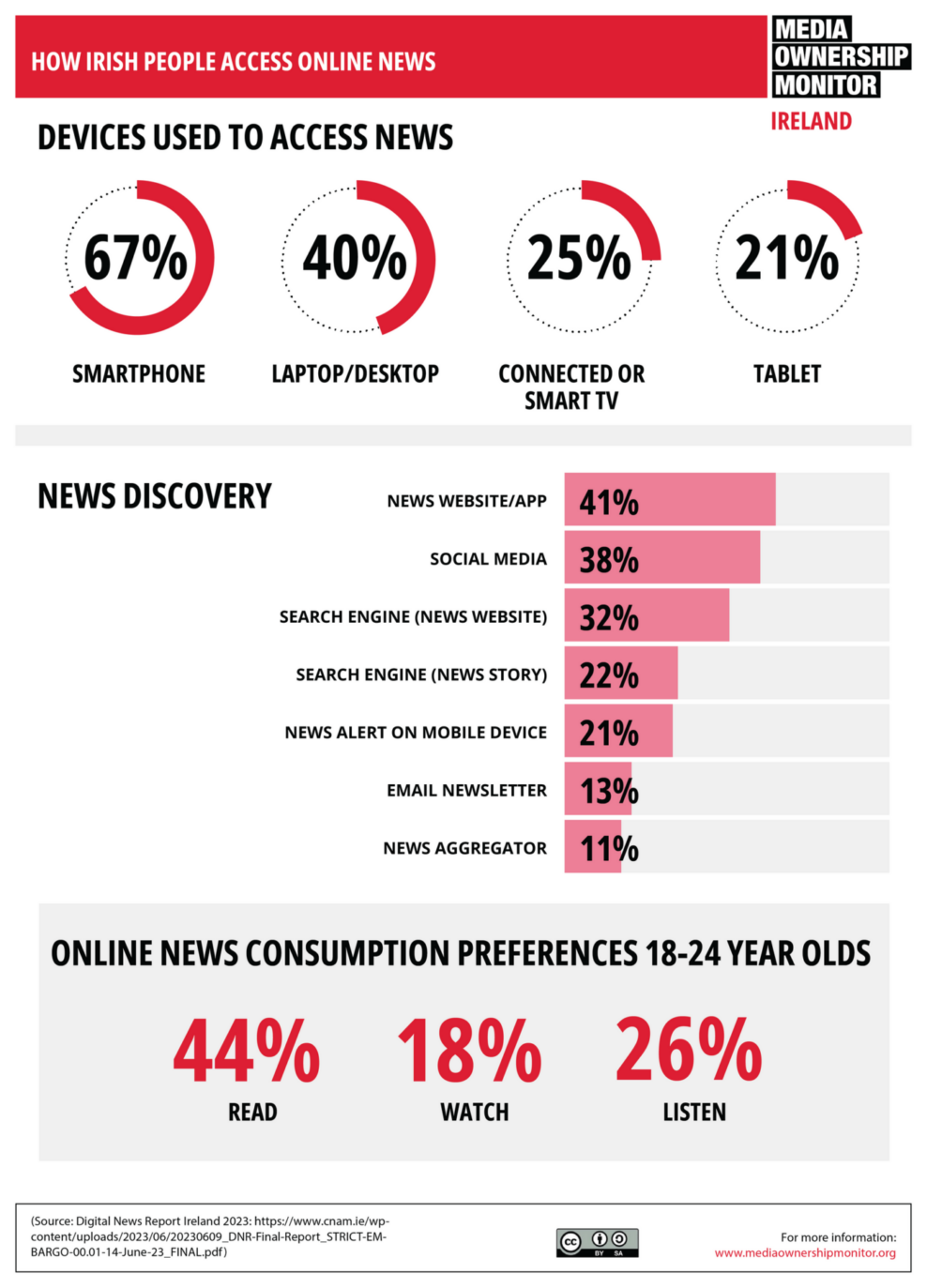
This is reflected in a gradual increase in the use of social media as a source of news. According to the Reuters Digital News Report for Ireland, the percentage of the population using social media as their main source of news has increased from 16% in 2017 to 20% in 2023. (Online – excluding social media – has also increased from 28% to 32% over the same period and now ties with television as the main source of news.) Social media use for news is particularly prevalent amongst younger age cohorts: it’s the most common source of news for 18-24 year-olds and outstrips television, radio and print amongst 18-44 year-olds.
Ireland as Europe’s Big Tech Base
The following Tech companies have all set up their European Headquarters (and in many cases their EMEA HQ) in Ireland: Google, Facebook, Twitter, TikTok, LinkedIn, Microsoft, Ebay, Amazon, PayPal, IBM, Apple and Airbnb. Indeed the offices of Google, Facebook, Twitter, Airbnb, Tiktok, LinkedIn, Amazon are all within a short walk of one another close to the Grand Canal Docks area of the city. The presence of so many companies in the same sector is not simply an agglomeration effect but reflects one of the central planks of Irish economic policy since the late 1950s: actively encouraging Foreign Direct Investment (FDI).
The gradual reduction of the standard corporation tax rate from 40% to 12.5% between 1996 and 2003 came to constitute a key incentive for overseas firms to establish in Ireland. Initially the courting of FDI by bodies such as the Industrial Development Authority had focused on labour-intensive manufacturing industries. However, with the emergence of the nascent Tech Giants from the late 1990s onwards, Ireland’s low corporation tax rate took on a new (and probably unforeseen) significance. The inherently transnational nature of the activities of online platforms influenced new revenue attribution strategies. A social media platform might raise revenues through selling advertising in a myriad of countries but those revenues could be – legally – attributed to whatever country the platform registered its headquarter operations in. There is a strong incentive to attribute revenues (and in particular profits) to whatever location offered the lowest corporation tax rates and since 2003 Ireland has consistently offered the lowest rates in the European Union.
Apple Ireland’s 2022 accounts recorded revenues of €204.1 billion and profits of €63.5 billion. Though they do not report Irish corporation tax payments, applying the 12.5% standard corporation tax rate to those profits would result in a tax bill of €7.9 billion. Google Ireland reported revenues of €64.8 billion in 2021. Gross profits were €50.5 billion but pretax profits were just €2.84 billion and the company paid €395.8 million in corporation tax.
Meta Platforms Ireland Limited recorded revenues of €52.3 billion in 2021 and pre-tax profits of €1.184 billion. The firm paid €699.3m in corporation tax comprising €485.89mm relating to the company’s 2021 activities plus a further €212.3m to resolve outstanding tax matters relating to previous years.
Microsoft’s two main Irish subsidiaries (Microsoft Ireland Operations Limited and Microsoft Ireland Research) recorded cumulative revenues of €104 billion in 2022. This resulted in a corporation tax bill of €2.7 billion.
In short, Irish tax revenues are disproportionately reliant on revenues levied on the Tech Giants. And, regardless of whether such corporations seek to exploit the leverage their continued presence in Ireland constitutes when dealing with the Irish state, it is manifestly obvious that such leverage is potentially available to them.
There are two “notorious” contexts in which this potential influence might be considered. The first is the long-running dispute between the European Commission and Apple regarding Apple’s Tax Liability in Ireland. In 2016, after a two-year investigation, the Commission published a report in which it concluded that Apple’s tax arrangements in Ireland between 2004 and 2014 constituted a form of state aid and was thus illegal under EU Competition Rules. The Commission argued that the particular manner in which Apple had availed of the Double Irish scheme (see above) was dependent on two rulings from the Irish Revenue Commissioners specific to Apple. Since these rulings did not apply to other companies, the Commission adjudged that Apple had effectively received preferential treatment which constituted a form of state aid. According to the Commission the effect of this was to reduce Apple’s effective tax rate in Ireland from 1% in 2003 to 0.005% by 2014. Given this the Commission ordered Apple to repay the taxes it should have been liable for, a sum equivalent to €13bn plus interest.
Irish State and Apple Side by Side
Apple immediately moved to appeal the judgement while depositing €13bn into an escrow account while the appeal took place. Perhaps surprisingly, the Irish state actively supported Apple’s appeal arguing that Apple had not received any special tax advantages. The apparent eagerness of the state to avoid receipt of a sum then equivalent to 10% of GDP might seem surprising. However, it is critical to emphasise that, from the perspective of the Irish government, the Commission ruling threatened to undermine a key element of Ireland’s competitive offering when seeking to attract transnational capital. In July 2020, the European General Court found in favour of Apple, stating that the Commission had failed to demonstrate that Apple had received special tax advantages from the Irish state to the required legal standard. The ruling was met with quiet relief by the Irish government but was immediately appealed by the Commission. As of summer 2023 the appeal process is still ongoing (and will not be completed until November of that year). However, it appears unlikely that the European Court of Justice will reverse the July 2020 decision.
Irish Data Protection Commission: A ‘Safe Harbour’ for Data?
The other major context in which we might consider relates to the connections between the Irish Data Protection Commission (DPC), General Data Protection Regulations (GDPR) and how the latter are applied to the Tech Giants located in Dublin and thus under the regulatory purview of the DPC. In 2013, an Austrian law student, Max Schrems filed a complaint against Facebook with the Irish Data Protection Commission arguing that Facebook was transferring his personal data (and that of all EU-based Facebook users) to the United States in a manner which contravened the EU’s data protection legislation. The EU’s legislation prohibits the transfer of data relating to EU citizens to non-EU countries unless the company transferring the data can guarantee that it is “adequately” protected. Schrems' complaint occurred in the context of the 2013 revelations from whistleblower Edward Snowden regarding the US National Security Agency’s operation of its PRISM programme which collected user communications content from a variety of tech companies (including Facebook) for intelligence purposes. In effect Schrems argued that in transferring data relating to EU citizens to Facebook in the US, Facebook was potentially making that data available to the NSA. The then Irish Data Protection Commissioner rejected the complaint citing the existence of the 2000 US-EU “Safe Harbour” agreement which guaranteed a free flow of data between the EU and US provided the tech companies transferring that data accepted the jurisdiction of US enforcement bodies. Schrems appealed the decision to the Irish High Court who in turn referred it to the Court of Justice of the European Union. In September 2015, the Advocate-General of the Court, concluded that, in the light of the Snowden revelations, the 2000 Safe Harbour agreement was invalid as it could not be regarded as offering sufficient guarantees relating to the security of EU user data.
Although the Court decision meant that the hands of the DPC were no longer tied by the Safe Harbour agreement, Facebook specifically continued to transfer data arguing that it was permitted to do so on the basis of “standard contractual clauses” (SCCs) agreements which individual users signed up to a precondition for activating Facebook accounts. In December 2015 Schrems resubmitted his original Facebook-related complaint to the Irish DPC arguing that the SCCs should also be subject to the European Court ruling. The complaint was once again referred to the Irish High Court which, in March 2017, essentially agreed with Schrems’ position.
GDPR and Relations with Big Tech
Whether fairly or not, the tendency of the Irish DPC to “refer up” when faced with difficult data protection cases and the delays in responding to data protection-related complaints has created a perception within the European Parliament that the Irish regulator may not be up to the task of policing the Tech giants under their jurisdiction. In May 2021, The European Parliament passed a resolution calling on the European Commission to open an infringement procedure against Ireland for failing to enforce the General Data Protection Regulation (GDPR) introduced in 2018. In a 2023 address to MEPs, the current Irish Data Protection Commissioner Helen Dixon rejected a narrative which framed the DPC as being repeatedly forced to adopt a tougher stance with regard to tech giants by regulators from other EU member states. That narrative is exemplified by a 2023 report from the Irish Council for Civil Liberties (ICCL). The ICCL noted that 67% of the Irish Data Protection Commission’s GDPR investigation decisions in EU cases have been overruled by majority vote at the European Data Protection Board (EDPB). In all cases the EDPB members have sought tougher enforcement actions.
The ICCL also notes that of the 55 cross-border cases relating to GDPR concluded by the Irish DPC between 2018 and 2022, 46 were resolved through “amicable resolution”. Given that 9 out of 10 complaints referred to the DPC involved just eight tech giants, the ICCL query the efficacy of this amicable approach noting that EDPB guidelines specifically counsel against using the amicable approach for repeat offenders.
The clear implication – whether fair or not – is that the strategic importance of having tech giants headquartered in Ireland constitutes a disincentive to adopt a stricter approach to their regulation.
Irish Times, 13 June 2018, Mark Paul, “Ireland is the world’s biggest corporate ‘tax haven’.
Irish Times, 7 April 2023, Apple reports €63.5bn profit at main Irish subsidiary.
Irish Times, 7 April 2023, Two Microsoft Irish subsidiaries paid more than €2.7bn in corporate tax last year.
Joe Brennan “Ireland wins appeal in €13 billion Apple tax case“ Irish Times, July 15 2020.